
In industrial facilities, warehouses, and on construction sites, selecting the right material handling equipment is critical to both operational efficiency and worker safety. While pallet trucks and forklifts may be used for similar tasks, they differ significantly in design, load capacity, maneuverability, and overall performance.
Understanding the Equipment Differences
Design and Construction Principles
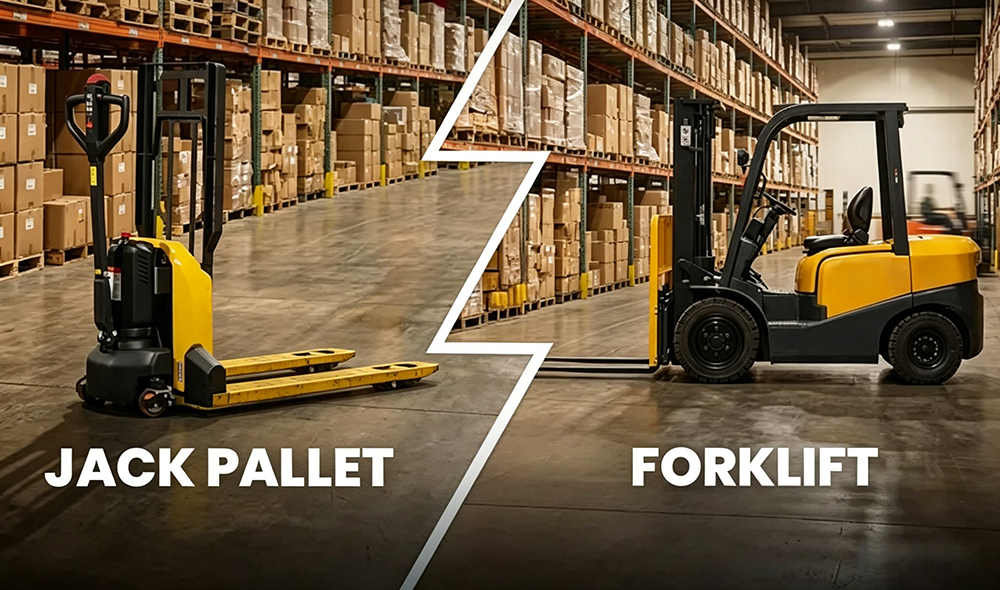
Pallet trucks are built with a compact, low-profile design intended primarily for horizontal transport. Their hydraulic pump, steering tiller, and fork structure are engineered to lift pallets just a few centimeters off the ground — just enough to move the load. This mechanical simplicity is deliberate: the equipment performs a focused function with few components and minimal maintenance requirements.
A forklift, by contrast, is a fully engineered vehicle equipped with a powertrain, hydraulic lifting system, mast assembly, and counterweight. Its structure makes substantial vertical movement possible and allows it to handle heavy or unbalanced loads safely. Forklifts integrate advanced safety features, stability control systems, and — depending on the model — electric, diesel, or LPG drive lines. These fundamental differences explain why pallet trucks and forklifts, though both used in material handling, deliver completely different levels of performance.
Load Capacity and Performance
Pallet trucks typically offer a load capacity between 1,000 and 3,500 kg, depending on whether they are manual or electric models. Their lift mechanism is not designed for significant vertical reach; instead, it is optimized for moving palletized loads across short distances. With this limited capacity, they fit well in warehouses, retail environments, and controlled indoor settings.
Forklifts, on the other hand, can handle much heavier loads. Depending on the class and model, capacities range from 1 tonne to over 50 tonnes, making them indispensable in logistics hubs, industrial warehouses, construction sites, and heavy manufacturing plants. A forklift can lift loads several meters high, enabling stacking, racking, and container handling — tasks that are beyond the capability of any pallet truck.
This capacity gap is why forklifts are regarded as true heavy construction machinery, while pallet trucks remain essential yet basic warehouse tools.
Working Range and Conditions
Pallet trucks perform best on flat, smooth surfaces such as warehouse floors. Their wheel configuration and steering geometry are not built for rough terrain or outdoor use. Operators use them mainly for short-distance load transfers, small-batch movements, and jobs that demand agility in tight spaces.
Forklifts are engineered for far greater operational flexibility. Depending on the type — counterbalance forklift, reach truck, or rough-terrain forklift — they can work indoors, outdoors, and on unpaved or uneven ground. Forklifts can travel longer distances while keeping loads stable, which makes them essential for large facilities and outdoor yards.
When a workplace includes obstacles, ramps, or changes in terrain, a forklift delivers superior handling, traction, and operational safety.
Precision, Maneuverability, and Control
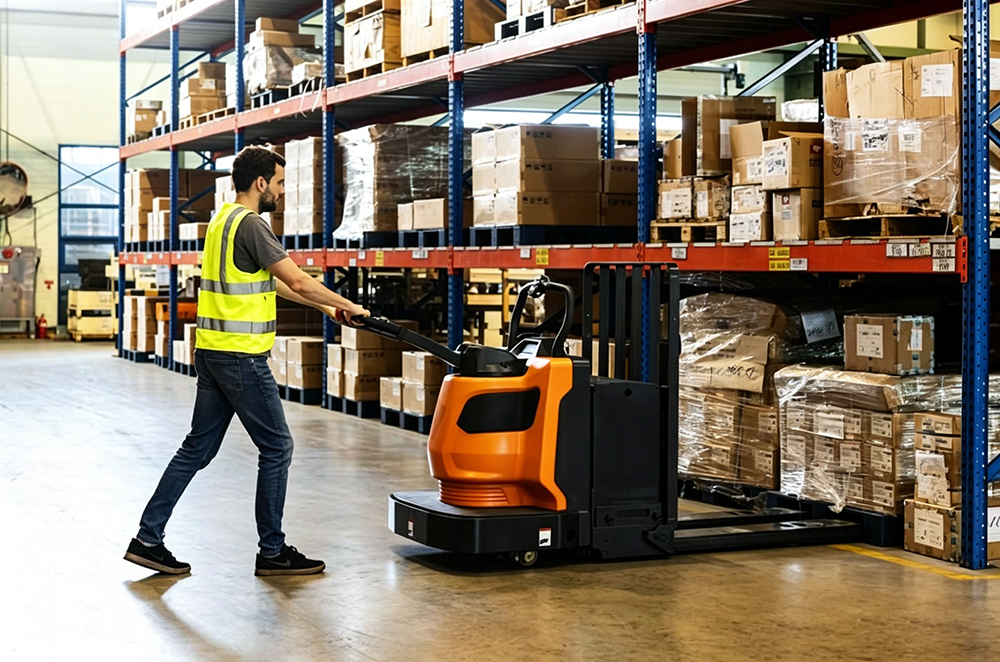
Thanks to their compact size, pallet trucks are easy to operate. Manual pallet trucks rely entirely on the operator’s strength and steering control, while electric pallet trucks incorporate a powered drive that enhances maneuverability. Still, compared with forklifts, their turning radius, travel speed, and directional precision remain limited.
Choosing the Right Machine for Your Job Site
Deciding between a pallet truck and a forklift is not simply a matter of preference — it is a question of engineering suitability. The right choice hinges on several operational variables:
- Load weight and dimensions
- Required lift height
- Facility size and layout
- Floor surface and terrain conditions
- Frequency of operation
- Safety requirements
In settings where vertical movement is minimal and loads are moderate, a pallet truck can meet operational needs efficiently. However, wherever vertical stacking, outdoor loading and unloading, or handling large and heavy materials is required, the forklift becomes the more strategic investment.
DAXLIFTER forklifts stand out for their structural durability, high load capacity, and operator-centered design — delivering reliable, high-performance equipment built for the toughest work environments.
The Role of Technology in Material Handling
Modern forklifts incorporate a range of advanced technologies, including telematics systems, operator assistance features, improved hydraulic efficiency, and load monitoring sensors. These innovations boost safety, reduce downtime, and enhance operational precision. Electric forklifts are especially popular today thanks to their lower emissions, reduced noise levels, and better environmental performance.
Pallet trucks, while simpler in construction, have progressed as well. Electric pallet trucks now offer higher travel speeds, lighter operator effort, and integrated braking systems. Yet, compared with the innovations driving the forklift industry, their technological advances remain relatively modest.
This technology gap underlines why forklifts have become indispensable for businesses looking for long-term, dependable operation from their heavy equipment.
At DAXLIFTER, we provide more than just heavy equipment — we deliver complete solutions. Contact us today by phone or email sales@daxlifter.com / WhatsApp: +86 15192782747, and our team will be happy to help you select the model that best fits your needs.
Post time: Apr-25-2026