
When setting up or upgrading an automotive repair shop, selecting the right lift is one of the most critical decisions you will make. The two most popular contenders—2-post lifts and 4-post lifts—both offer reliable lifting performance, but they cater to very different types of service. Choosing the right one can skyrocket productivity and maximize floor space; the wrong choice can limit your service range.
In this guide, DAXLIFTER breaks down how each lift works, their best use cases, and the key factors that should drive your decision.
2-Post vs. 4-Post Car Lifts: The Fundamentals
While both systems are engineered to safely elevate vehicles, they utilize distinct structures and lifting mechanisms.
-
Comparison Overview
| Feature | 2-Post Car Lift | 4-Post Car Lift |
| Definition | A lift supported by two vertical columns with adjustable arms that engage the vehicle's frame. | A drive-on lift supported by four columns, using runways to support the tires. |
| Lifting Method | Uses hydraulic cylinders and synchronization cables to lift the vehicle from the chassis. | Uses a hydraulic and cable system to raise the entire runway (and the vehicle) as one unit. |
| Positioning | Vehicle is driven between posts; arms must be manually spotted at lifting points. | Vehicle is simply driven onto the runways with minimal alignment required. |
| Common Uses | General mechanical repairs, suspension/brake work, and chassis maintenance. | Long-term storage, wheel alignments, detailing, and heavy-duty inspections. |
Key Factors to Consider Before Buying
-
1. Workshop Floor Space
Layout is a deciding factor. 2-post lifts have a compact footprint, keeping the area beneath the vehicle clear, making them ideal for tight spaces. 4-post lifts require a larger footprint due to the runways and need extra "approach" space for driving on and off.
-
2. Vehicle Access
The biggest differentiator is undercarriage access.
2-Post Lifts: Offer almost total access to the chassis, wheels, and suspension.
4-Post Lifts: While great for under-engine work, the runways can obstruct access to wheels and brakes unless you add auxiliary equipment like rolling bridge jacks.
-
3. Safety and Stability
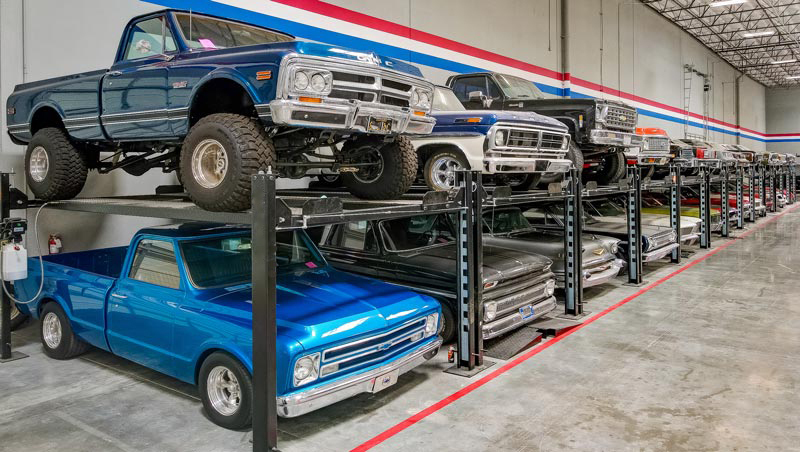
Both are safe when used correctly, but they feel different. A 2-post lift relies on being anchored into high-spec concrete and precise arm placement. A 4-post lift provides inherent stability by distributing weight across four points, making it the superior choice for long-term vehicle storage and heavier loads.
-
4. Installation Requirements
2-Post Lifts: Require a thick, high-PSI concrete slab for secure anchoring due to the high center of gravity.
4-Post Lifts: Have less demanding concrete requirements as the weight is spread out; some smaller "parking versions" can even be used without permanent anchoring.
-
5. Versatility and Multi-use
If your shop handles a high volume of wheel and brake jobs, the 2-post is the most flexible tool. However, the 4-post lift wins on versatility if you need to double your parking capacity or perform precision wheel alignments.
-
6. Ease of Use
For a busy shop, "drive-on" convenience saves time. A 4-post lift allows a technician to position a car in seconds. A 2-post lift requires more care to ensure the lifting arms are correctly positioned on the factory jacking points to prevent damage or imbalance.
-
7. Long-Term Return on Investment (ROI)
While 2-post lifts generally have a lower initial cost, 4-post lifts offer added value through their storage capabilities and suitability for heavy-duty or specialty alignment services. Consider your most frequent service tasks to determine which will pay for itself faster.
Why Choose DAXLIFTER for Your Next Shop Upgrade?
At DAXLIFTER, we don't just sell equipment; we provide solutions tailored to your workflow, space constraints, and vehicle types. Whether you need the agility of a 2-post mechanical lift or the rock-solid stability of a 4-post storage system, our products are compliant, durable, and built for the modern technician.
Get a Personalized Quote Today
Ready to take your workshop to the next level? Contact the DAXLIFTER engineering team for expert advice and competitive pricing.
Email: sales@daxlifter.com
WhatsApp: +86 15192782747
Website: Contact us today for customized layout designs.
Post time: Mar-28-2026